ZERI Pavilion Manizales: Simón Vélez Masterpiece in Colombia
Simón Vélez: The Master of Bamboo Architecture
Colombian architect Simón Vélez has spent over four decades transforming the perception of bamboo — specifically guadua angustifolia, a species native to the Andean region — from a material associated with poverty into a medium for bold, structurally ambitious architecture. Born in Manizales in 1949, Vélez studied architecture at the Universidad de los Andes in Bogotá before returning to the Coffee Region (Eje Cafetero) where guadua grows abundantly in the river valleys and mountain slopes.
Vélez’s breakthrough insight was that guadua bamboo, when properly treated and joined, possesses a tensile strength comparable to steel and a compression resistance that rivals concrete — at a fraction of the weight, cost, and environmental footprint. His career has been dedicated to proving this through built work: churches, bridges, convention centers, and pavilions that push the structural limits of what bamboo can achieve.
Key Innovations in Guadua Construction
- Bolted mortar joints: Vélez developed a technique of filling bamboo culm ends with cement mortar and inserting threaded steel bolts, creating connections that can transfer substantial loads. This innovation solved bamboo’s traditional weakness at joints.
- Immersion treatment: Guadua poles are immersed in boron-salt solutions for several weeks, protecting against insect attack and fungal decay without toxic chemicals.
- Large-span structures: By combining treated guadua with steel cables and minimal concrete foundations, Vélez has achieved roof spans exceeding 30 meters — dimensions previously considered impossible for bamboo.
- Hybrid systems: His designs often combine guadua with local materials such as bahareque (wattle-and-daub), stone, and recycled timber, creating structures deeply rooted in regional building traditions.
The ZERI Philosophy
The ZERI Pavilion in Manizales is named after the Zero Emissions Research and Initiatives foundation, created by Belgian-born economist and entrepreneur Gunter Pauli. ZERI promotes a “blue economy” model in which industrial and agricultural waste from one process becomes the input for another, eliminating the concept of waste entirely.
Pauli and Vélez first collaborated in the late 1990s, united by a shared conviction that sustainable development required not just cleaner technology but fundamentally different materials and design philosophies. Bamboo — a grass that grows to maturity in 3-5 years, sequesters carbon at rates exceeding most tropical hardwoods, and regenerates from its root system after harvesting — embodied ZERI’s principles perfectly.
The ZERI Foundation commissioned Vélez to design a series of structures demonstrating that bamboo could serve as the primary structural material for buildings of civic and cultural significance. The Manizales pavilion became the most prominent realization of this vision.
The ZERI Pavilion: Design and Construction
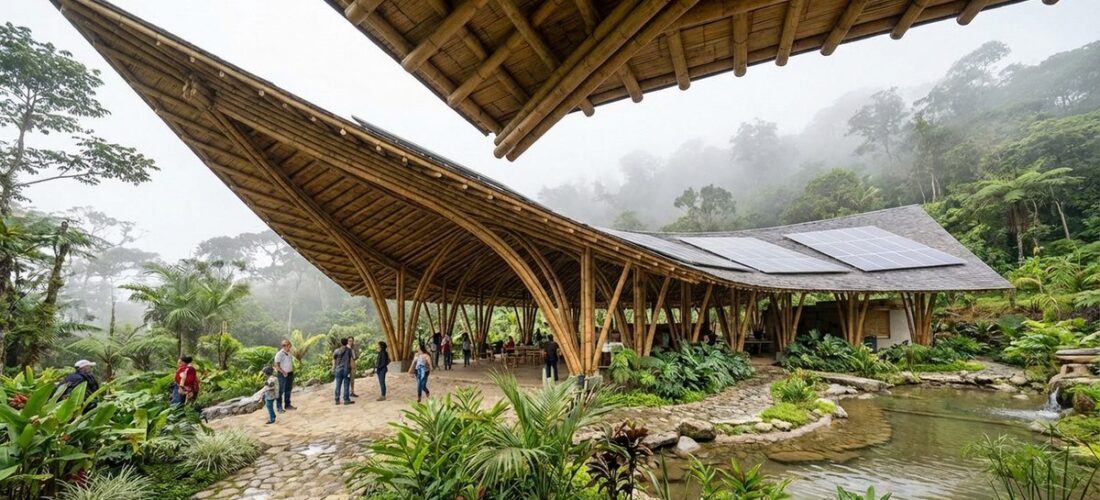
Located in Manizales, the capital of the Caldas department in Colombia’s Coffee Region, the ZERI Pavilion stands as one of the most photographed and studied bamboo structures in the world. The building showcases Vélez’s mature structural vocabulary: soaring guadua columns supporting a dramatic roof canopy, with the bamboo elements left exposed to reveal the elegance of the construction system.
Structural Design
The pavilion’s roof structure employs a system of guadua trusses and arches that distribute loads across multiple points, creating a column-free interior space beneath sweeping eaves. The roof geometry is designed to shed the Coffee Region’s heavy rainfall while allowing natural ventilation through clerestory openings. Key structural features include:
- Primary columns: Clusters of 4-6 guadua culms bound together, each approximately 12 centimeters in diameter, creating composite members with substantial load-bearing capacity.
- Roof trusses: Triangulated guadua members with bolted mortar joints, spanning the full width of the structure without intermediate supports.
- Tension cables: Minimal steel cable elements complement the guadua structure at critical points, demonstrating the hybrid approach that characterizes Vélez’s most ambitious work.
- Foundation system: Concrete pad foundations anchor the bamboo columns, with a careful moisture barrier preventing ground water from wicking into the bamboo.
Material Sourcing and Preparation
All guadua used in the pavilion was harvested from managed stands within the Caldas and Risaralda departments, typically within 50 kilometers of the construction site. The bamboo was harvested at 4-5 years of maturity — the optimal age for structural use — and treated through immersion in boron solutions for 3-4 weeks before air-drying to approximately 12% moisture content. This local sourcing dramatically reduced the project’s embodied energy compared to conventional steel or concrete construction.
Cultural Significance
The ZERI Pavilion holds particular cultural resonance in the Coffee Region, where guadua has been a vernacular building material for centuries. Traditional bahareque construction — timber frames filled with woven bamboo and mud plaster — defined the architectural identity of towns like Salamina, Aguadas, and Manizales itself before the widespread adoption of reinforced concrete in the mid-20th century.
By elevating guadua from vernacular material to the protagonist of a landmark public building, Vélez and the ZERI Pavilion contributed to a broader cultural revaluation. In 2011, UNESCO inscribed the Coffee Cultural Landscape as a World Heritage Site, explicitly recognizing the region’s traditional architecture — including bahareque construction — as a key element of its outstanding universal value. The ZERI Pavilion, while contemporary in design, participates in this heritage by demonstrating the continuity and evolution of bamboo building culture.
Influence on Colombian Architecture
The pavilion has inspired a generation of Colombian architects and engineers to explore guadua as a serious structural material. The Universidad Nacional de Colombia in Manizales and the Universidad Tecnológica de Pereira both operate bamboo research laboratories that test structural properties, develop new joint systems, and train builders in proper treatment and construction techniques. Colombian building codes now include specific provisions for engineered bamboo structures — a regulatory achievement directly influenced by the built evidence of projects like the ZERI Pavilion.
Tourism and Visitor Experience
The ZERI Pavilion has become a destination for architectural tourism in the Coffee Region, attracting professionals, students, and curious travelers drawn by its reputation as one of the world’s most significant bamboo structures. Visitors can observe the construction details up close — the bolted joints, the curving guadua elements, the interplay of light through the roof structure — gaining an appreciation for both the technical sophistication and the aesthetic warmth of bamboo architecture.
The pavilion is typically included in architectural tours of Manizales and the broader Coffee Region, alongside other notable Vélez projects and the traditional bahareque towns. For international visitors, the structure offers a tangible example of how indigenous materials and contemporary design thinking can produce architecture that is simultaneously sustainable, beautiful, and culturally grounded.
Visiting Information
- Location: Manizales, Caldas department, Colombia — accessible via La Nubia airport or by road from Pereira (45 min) or Bogotá (7 hours)
- Best season: The Coffee Region’s dry seasons (December-February and June-August) offer the most comfortable visiting conditions
- Combined itinerary: Visitors often combine a visit to the ZERI Pavilion with tours of coffee farms (fincas cafeteras), the Nevado del Ruiz volcano, and the traditional towns of Salamina and Aguadas
Vélez’s Legacy and Bamboo’s Future
Simón Vélez has received numerous international recognitions, including the Principal Prince Claus Award (2009) and exhibitions at major venues including the Museum of Modern Art in New York. His work, exemplified by the ZERI Pavilion, has fundamentally altered the global conversation about bamboo in architecture — moving it from the margins of “alternative” building into the mainstream of sustainable design discourse.
As Latin American cities confront the dual challenges of rapid urbanization and climate change, the principles embodied in the ZERI Pavilion — local materials, low embodied energy, cultural continuity, and structural innovation — offer a compelling model for the architecture of the future.