Villa 31 Buenos Aires: Comprehensive Neighborhood Reurbanization
Villa 31: The Comprehensive Reurbanization of Buenos Aires’ Most Iconic Informal Settlement
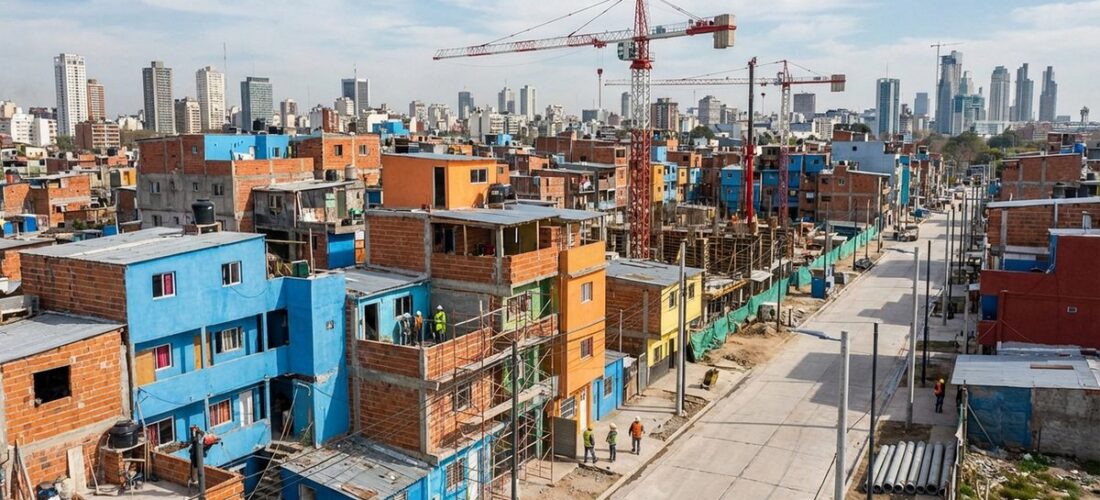
Villa 31, officially known as Barrio Padre Carlos Mugica, is one of the oldest and most prominent informal settlements in Buenos Aires, Argentina. Located in the heart of the city — adjacent to the upscale Retiro neighborhood and just steps from the central bus terminal — Villa 31 has been at the center of debates about urban inequality, housing rights, and inclusive city planning for over eight decades.
The comprehensive reurbanization project launched in 2016 represents one of the most ambitious urban integration efforts ever undertaken in Latin America. Rather than demolishing the settlement and relocating its residents — the approach favored in previous decades — the project aimed to upgrade Villa 31 in place, transforming it from an informal settlement into a fully integrated neighborhood with proper infrastructure, public services, and legal property rights.
Historical Background: Eight Decades of Informal Urbanization
Origins in the 1930s
Villa 31’s history begins in the 1930s, when European immigrants — primarily from Italy, Poland, and Spain — settled on vacant land near the port and rail yards of Retiro. The area offered proximity to jobs at the docks, rail yards, and nearby commercial districts. What began as a temporary encampment gradually became permanent as residents built increasingly solid structures and established community institutions.
Through the 1940s and 1950s, the settlement grew as rural-to-urban migration brought waves of newcomers from Argentina’s interior provinces. During the Perón era, social housing programs addressed some of the demand, but Villa 31 continued to expand as housing production consistently fell short of need.
Demolition Attempts and Resistance
The military dictatorship of 1976-1983 attempted to eradicate Villa 31 as part of a broader campaign to “clean up” Buenos Aires before the 1978 World Cup. Thousands of residents were forcibly evicted, and large sections of the settlement were demolished. However, many residents returned after the fall of the dictatorship, and the settlement quickly regrew.
This cycle of attempted demolition and regrowth repeated several times, each attempt generating fierce resistance from residents and their allies. Father Carlos Mugica, a Catholic priest who worked in the villa and advocated for residents’ rights, was assassinated in 1974 — his name was later given to the neighborhood in recognition of his work.
Growth and Consolidation
By the early 2000s, Villa 31 had grown to house an estimated 26,000 people on roughly 32 hectares. A second section, known as Villa 31 bis, had developed on adjacent land. The settlement included multi-story buildings (some reaching six or seven floors), commercial districts, churches, schools, and a vibrant informal economy. Immigration from Bolivia, Paraguay, and Peru added to the neighborhood’s cultural diversity.
Despite its central location and economic vitality, Villa 31 lacked basic infrastructure that surrounding neighborhoods took for granted: paved streets, reliable water and sewer connections, legal electricity, formal addresses, and access to municipal services.
The Reurbanization Project: A New Approach
In 2009, the Buenos Aires city legislature passed Law 3343, which formally committed the city to the urbanization — not demolition — of Villa 31. This legal framework was groundbreaking: it recognized residents’ right to remain in their homes and mandated the provision of full urban services. However, implementation was slow, and it was not until 2016 that the project gained significant momentum.
Project Scope and Objectives
The reurbanization project, overseen by the Secretaría de Integración Social y Urbana (SECISYU), was designed around several core objectives:
- Infrastructure installation: Complete water, sewer, drainage, electricity, natural gas, and telecommunications networks
- Street formalization: Paving and naming of streets to create a legible urban grid connected to the surrounding city
- Housing improvement: Structural reinforcement of existing buildings and construction of new housing for residents displaced by infrastructure works
- Public space creation: Parks, plazas, and community facilities integrated throughout the neighborhood
- Land tenure regularization: Granting formal property titles to residents, providing legal security and access to credit
- Social programs: Education, health, employment, and cultural programs to support the integration process
Infrastructure: Building the Invisible City
The most fundamental — and least visible — component of the reurbanization was the installation of underground infrastructure. In a settlement that had grown organically over decades, there were no underground utility corridors, no formal drainage system, and no standardized connections to city services.
The infrastructure program involved:
- Installation of over 20 kilometers of water mains and individual connections to every dwelling
- Construction of a complete sewer network replacing the open channels and improvised connections that had posed severe health risks
- Installation of formal electricity distribution replacing the dangerous informal connections that had caused frequent fires
- Natural gas connections replacing bottled gas, reducing costs and fire risk for residents
- A stormwater drainage system to address chronic flooding that had affected lower-lying areas of the settlement
The Illia Highway Conversion
One of the project’s most dramatic interventions was the conversion of a section of the Autopista Illia, an elevated highway that bisected the settlement, into a ground-level boulevard. The highway had been a physical and symbolic barrier, separating Villa 31 from the rest of the city and creating a dark, underutilized space beneath its elevated structure.
The conversion created a new urban boulevard with pedestrian areas, cycling lanes, commercial spaces, and a new Ministry of Education building — deliberately located in the heart of the former villa to signal the government’s commitment to integration. This symbolic gesture of moving a major government office into the neighborhood was widely seen as a powerful statement about urban inclusion.
Social Outcomes and Community Impact
Property Rights and Economic Integration
The granting of formal property titles represented a profound change for residents who had lived for decades — in some cases, generations — without legal recognition of their homes. Property formalization enabled residents to:
- Access formal banking services and credit, using their homes as collateral
- Receive formal addresses, enabling access to services that require a verified residence
- Invest in home improvements with greater confidence in their tenure security
- Pass property to heirs through legal channels, reducing family conflicts and insecurity
Education and Health
The reurbanization included construction of new educational facilities, from early childhood centers to vocational training programs. Health services were expanded with a new primary care center and improved emergency access — previously, narrow unpaved streets had made ambulance access nearly impossible in some areas.
Employment and Economic Development
The construction phase of the project itself generated significant employment for residents. Training programs in construction skills, plumbing, and electrical work provided marketable skills that extended beyond the project. A commercial corridor was developed along the new boulevard, formalizing the vibrant informal economy that had long been a feature of the neighborhood.
Challenges and Criticisms
The reurbanization has not been without controversy. Critics have raised several concerns:
- Displacement risk: Despite commitments to in-place upgrading, some residents were displaced by infrastructure works, and replacement housing was not always adequate or timely
- Gentrification pressure: The neighborhood’s central location and improved infrastructure have raised concerns about rising property values displacing long-term residents
- Pace of implementation: Progress has been slower than initially promised, with some infrastructure works taking years longer than planned
- Community participation: While participatory mechanisms were established, some residents felt that meaningful input was limited, and decisions were often made without adequate consultation
- Political instrumentalization: The project has been criticized as being used for political purposes, with different administrations claiming credit while sometimes shifting priorities
Current Status
As of the mid-2020s, the reurbanization of Villa 31 remains a work in progress. Significant achievements include the completion of major infrastructure networks, the highway conversion, the construction of new public facilities, and the beginning of the property titling process. However, substantial work remains, particularly in housing improvement, complete infrastructure connections to all dwellings, and the social programs needed to support full integration.
The neighborhood, now officially Barrio Padre Carlos Mugica, houses an estimated 40,000 people and continues to evolve. Its transformation from Argentina’s most visible informal settlement to an integrated urban neighborhood — however incomplete — represents a significant shift in how Latin American cities approach informal urbanization.
Significance for Latin American Urban Policy
Villa 31’s reurbanization is significant far beyond Buenos Aires. Across Latin America, an estimated 100 million people live in informal settlements, and the question of how to integrate these communities into the formal city is one of the region’s most pressing urban challenges.
The Villa 31 project demonstrates several important principles:
- In-place upgrading is viable even in large, dense informal settlements — demolition and relocation are not the only options
- Legal frameworks matter: The 2009 law provided a foundation for sustained investment and protected residents’ rights through changes in political leadership
- Integration requires more than infrastructure: Social programs, economic opportunities, and community participation are essential complements to physical improvements
- Central locations create both opportunities and risks: The neighborhood’s valuable location drives investment but also creates displacement pressures that must be actively managed
As cities across the region grapple with similar challenges — from the favelas of Rio de Janeiro to the barriadas of Lima — Villa 31’s experience, with both its successes and its shortcomings, provides invaluable lessons for the future of inclusive urban development in Latin America.