Tarapoto: Sustainable Development in the Peruvian Rainforest
Tarapoto: A Model for Sustainable Development in the Peruvian Amazon
Nestled in the upper Amazon basin of northeastern Peru, Tarapoto has emerged as one of the most compelling examples of sustainable urban development in the Latin American rainforest. This city of approximately 180,000 inhabitants, capital of the San Martín province, has undergone a remarkable transformation from a region once plagued by deforestation and coca cultivation to a nationally recognized leader in environmental stewardship and sustainable growth.
Tarapoto sits at the intersection of three distinct ecological zones — the high jungle (selva alta), the low jungle (selva baja), and the Andean foothills — giving it extraordinary biodiversity and equally extraordinary environmental challenges. Its story offers critical lessons for cities across the tropics grappling with the tension between economic development and ecological preservation.
Historical Context: From Crisis to Opportunity
In the 1980s and early 1990s, the San Martín region was one of Peru’s most troubled areas. Coca production had devastated large swaths of forest, while the Shining Path insurgency created widespread instability. Deforestation rates were among the highest in the country, driven by slash-and-burn agriculture, illegal logging, and the coca trade.
The turning point came in the mid-1990s when a combination of government intervention, international development programs, and grassroots community organizing began to reshape the region’s trajectory. Alternative development programs introduced sustainable crops — cacao, coffee, and palm hearts — as replacements for coca. These programs laid the groundwork for what would become a broader sustainability movement.
By the early 2000s, Tarapoto had begun to attract attention from international organizations studying models of post-conflict sustainable development. The city’s experience demonstrated that environmental restoration and economic recovery could proceed hand in hand, a lesson that resonated across Latin America.
Sustainability Projects Transforming the City
Integrated Watershed Management
One of Tarapoto’s most significant achievements has been its approach to watershed management. The Cumbaza River basin, which supplies water to the city and surrounding agricultural areas, had been severely degraded by deforestation and erosion. Beginning in 2005, a comprehensive watershed restoration program was implemented involving:
- Reforestation of headwater areas with native species, protecting critical water sources
- Payment for ecosystem services (PES) schemes that compensated upstream farmers for maintaining forest cover
- Community-managed conservation areas that gave local populations both responsibility and benefits from forest protection
- Water quality monitoring systems involving local universities and community volunteers
The results have been measurable: sediment loads in the Cumbaza decreased by an estimated 35% over a decade, and dry-season water flows improved significantly, reducing water shortages that had previously affected tens of thousands of residents.
Sustainable Agriculture and Agroforestry
Tarapoto has become a hub for sustainable agricultural innovation in Peru. The region now produces some of the country’s finest organic cacao and specialty coffee, with cooperatives like Acopagro and Oro Verde gaining international recognition and fair-trade certification.
Agroforestry systems — which integrate tree crops with food production — have proven particularly well-suited to the region. These systems mimic the structure of natural forests, maintaining canopy cover while generating income from multiple products: timber, fruit, cacao, coffee, and medicinal plants. Studies by Peru’s National Institute for Agricultural Innovation (INIA) have shown that agroforestry plots in the Tarapoto area generate two to three times the income of conventional monoculture while maintaining significantly higher biodiversity.
Urban Green Infrastructure
Within the city itself, Tarapoto has invested in green infrastructure that reflects its rainforest setting. Key initiatives include:
- Urban tree planting programs that prioritize native species for shade and cooling
- Bioswales and rain gardens to manage stormwater runoff, critical in a city that receives over 1,200 mm of rainfall annually
- Green corridors connecting urban parks with surrounding forest areas, maintaining ecological connectivity
- Community gardens that provide food security while preserving traditional agricultural knowledge
Climate Adaptation Strategies
As a rainforest city, Tarapoto faces distinct climate challenges that are intensifying with global warming. Average temperatures in the San Martín region have risen by approximately 0.5°C over the past three decades, while rainfall patterns have become increasingly erratic — longer dry spells punctuated by more intense storms.
Flood Risk Management
Tarapoto has developed a multi-layered approach to flood risk that combines traditional knowledge with modern engineering. Rather than relying solely on concrete infrastructure, the city has embraced nature-based solutions: preserved wetlands serve as natural flood buffers, while upstream reforestation reduces peak flood flows. When hard infrastructure is needed, designs incorporate local materials and techniques that can be maintained without heavy equipment.
Heat Island Mitigation
Urban heat is a growing concern as the city expands. Tarapoto’s approach has focused on maintaining tree canopy cover within the urban area — a strategy that draws on the natural cooling effect of the surrounding forest. Municipal regulations now require new developments to maintain minimum green space ratios, and public spaces are designed with shade structures that use local bamboo and timber.
Water Security Planning
Climate variability has made water security a central concern. The city has invested in water storage infrastructure, including small reservoirs and improved distribution systems, while continuing to protect the watershed forests that regulate water supply. A climate adaptation plan developed with support from international partners identifies water security as the top priority and outlines actions through 2035.
Water Management Innovation
Water management in Tarapoto reflects the broader challenge of providing reliable urban water services in a tropical environment where abundance and scarcity can alternate rapidly. The city’s water utility, EMAPA San Martín, has implemented several innovative approaches:
- Decentralized treatment systems suited to the dispersed settlement patterns of a jungle city
- Constructed wetlands for wastewater treatment that are both effective and low-cost to maintain
- Rainwater harvesting programs that reduce demand on centralized infrastructure
- Real-time water quality monitoring at key points in the distribution network
A particularly noteworthy initiative has been the integration of traditional indigenous water management practices — developed over centuries by the Chazuta, Lamas, and other local peoples — into modern planning frameworks. This includes the protection of natural springs (ojos de agua) that serve as critical water sources for outlying communities.
Sustainable Architecture in the Selva
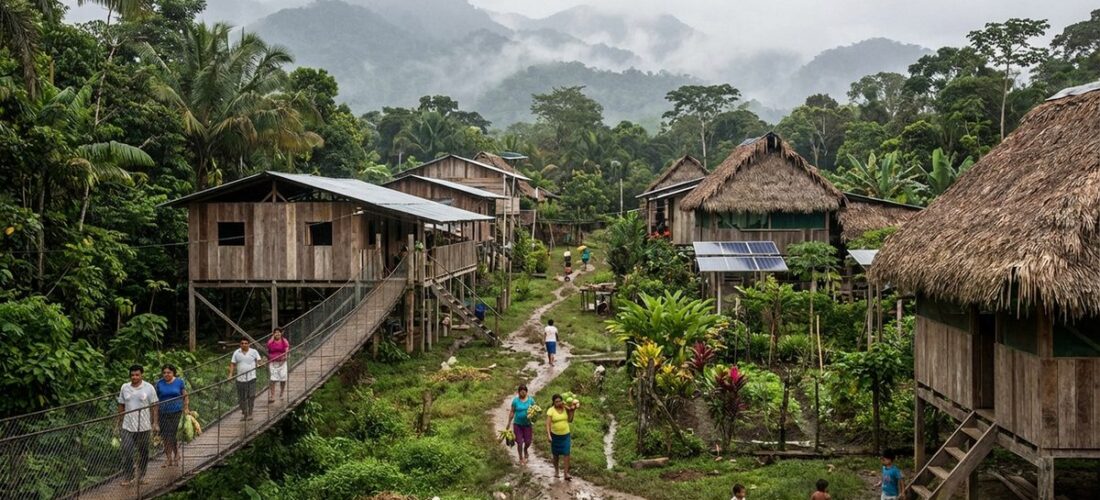
Construction in the Amazon poses unique challenges: extreme humidity, intense rainfall, abundant insect life, and the need for natural ventilation. Tarapoto has seen a revival of traditional building techniques adapted for modern use, creating an architecture that is both sustainable and culturally rooted.
Traditional Materials, Modern Design
Local builders have increasingly turned to bamboo (guadua), a material that grows abundantly in the region and has exceptional structural properties. Bamboo structures can be built quickly, resist earthquakes better than brick or concrete, and have a fraction of the carbon footprint. Several public buildings and community centers in Tarapoto now showcase bamboo construction techniques that are being studied by architects from across South America.
Adobe and rammed earth construction, traditional in the Andean foothills above the city, has also been revived for its thermal properties — keeping interiors cool during the day and warm at night without air conditioning. Modern adaptations include improved foundations and roof overhangs that protect earth walls from the heavy rains.
Passive Climate Design
Buildings designed for the Tarapoto climate emphasize cross-ventilation, elevated floors (to avoid flooding and improve airflow), deep roof overhangs, and shaded outdoor living spaces. These principles, drawn from traditional Amazonian architecture, dramatically reduce the need for mechanical cooling and represent a practical alternative to the energy-intensive construction methods spreading across urban Latin America.
The IUC-LA Program and International Cooperation
Tarapoto’s inclusion in the International Urban Cooperation — Latin America (IUC-LA) program marked an important milestone in the city’s development trajectory. Through the program, Tarapoto was paired with European partner cities to exchange knowledge and experience on sustainable urban development.
Key outcomes of the IUC-LA partnership included:
- Technical exchanges on integrated water resource management, drawing on European expertise in watershed governance
- Capacity building for municipal staff in climate adaptation planning and green infrastructure design
- Knowledge transfer on sustainable tourism development, helping Tarapoto leverage its natural assets without degrading them
- Policy development support for updating building codes and land use regulations to incorporate sustainability criteria
The partnership was particularly valuable in helping Tarapoto connect its local experiences to global frameworks like the Sustainable Development Goals (SDGs) and the New Urban Agenda. Local projects that had evolved organically could now be articulated in terms that attracted additional funding and recognition.
Lessons for Other Rainforest Cities
Tarapoto’s experience offers several transferable lessons for cities facing similar challenges across the tropics:
- Nature-based solutions are cost-effective: Protecting and restoring natural ecosystems often provides better and cheaper infrastructure services than engineered alternatives
- Traditional knowledge has modern value: Indigenous and local building techniques, agricultural practices, and water management systems can be adapted for contemporary urban challenges
- Post-conflict recovery and environmental restoration can reinforce each other: Economic alternatives to destructive activities can simultaneously restore ecosystems and livelihoods
- International partnerships accelerate progress: Access to technical knowledge and policy frameworks from other contexts helps local leaders articulate and advance their visions
- Community participation is essential: Tarapoto’s most successful programs are those with strong community ownership and participation
As climate change intensifies pressures on tropical cities worldwide, Tarapoto stands as evidence that sustainable development in the rainforest is not just possible but practical. The city’s journey from environmental crisis to sustainability model offers hope — and concrete strategies — for the hundreds of millions of people who call the world’s tropical forests home.