
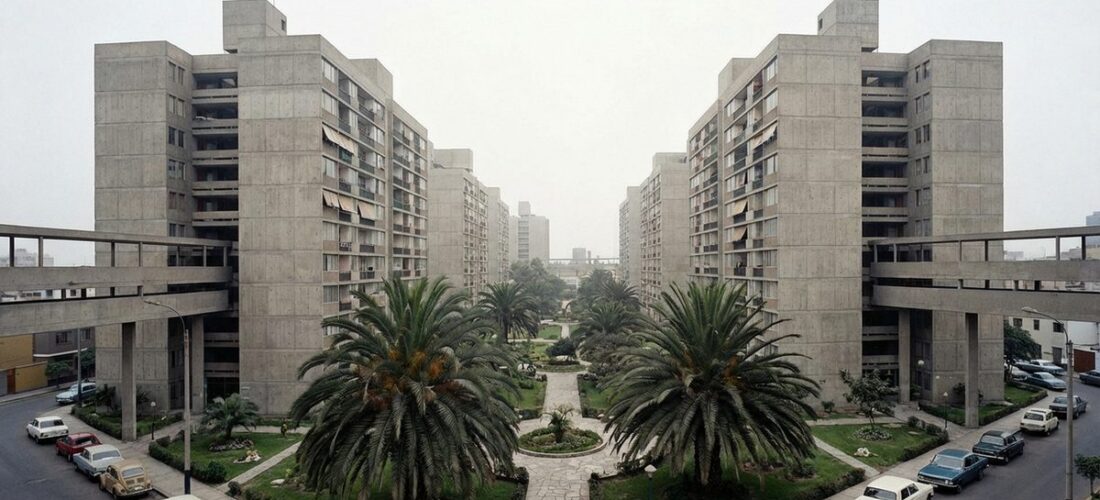
Residencial San Felipe in Jesús María: History and Urban Planning
A Modernist Housing Landmark in Lima
Residencial San Felipe, located in the Jesús María district of Lima, Peru, is one of the most significant modernist housing complexes in South America. Designed in the 1960s as a model of modern urban living, this ambitious project continues to serve as both a functioning residential community and an architectural landmark that embodies mid-century ideals of social housing and urban planning.
Historical context and design
The Residencial San Felipe was designed by architect Enrique Ciriani and a team of collaborators, commissioned by the government of President Fernando Belaúnde Terry (himself an architect) as part of a national housing modernization program. Construction began in 1964 and was completed in phases through the early 1970s.
The complex was designed to house approximately 30,000 residents in a mix of high-rise towers and mid-rise blocks arranged around a central civic space, the Ágora. The design reflected the influence of Le Corbusier and the CIAM (International Congresses of Modern Architecture) movement, adapted to Lima specific climate and social conditions.
Architectural features
- The Torres (Towers): Four 14-story residential towers that dominate the complex skyline, each housing hundreds of apartments with panoramic views of the city.
- The Ágora: A large central public space intended as a communal gathering place, surrounded by commercial facilities and community services.
- Pedestrian priority: The complex was designed with a clear separation of vehicular and pedestrian circulation, with most internal movement occurring on elevated walkways and ground-level pedestrian paths.
- Integrated services: The original design included schools, commercial areas, healthcare facilities, and recreational spaces within the complex, reflecting the modernist ideal of the self-contained neighborhood unit.
- Green spaces: Extensive gardens and planted areas between buildings, creating a green oasis within the dense urban fabric of Jesús María.
Social significance
Residencial San Felipe was originally designed for middle-class families, offering modern amenities at affordable prices through government-subsidized financing. The complex represented a new vision of urban living in Peru — one that combined the conveniences of apartment living with community services and public spaces that encouraged social interaction.
Over the decades, the community has developed a strong collective identity. Residents have organized to maintain common areas, advocate for building preservation, and celebrate the complex unique character through cultural events and community activities.
Conservation and heritage
In recent years, Residencial San Felipe has gained recognition as an important example of Latin American modernist architecture. Architectural historians and preservation advocates have called for its designation as a cultural heritage site, recognizing its significance as one of the few large-scale modernist housing projects in South America that continues to function largely as originally intended.
The complex faces ongoing challenges related to maintenance and modernization of aging infrastructure, with debates about how to balance preservation of the original architectural character with necessary updates to meet contemporary living standards.
Influence on urban planning
Residencial San Felipe continues to influence discussions about urban planning in Lima and across Latin America. As cities grapple with housing deficits and the need for denser, more sustainable urban forms, the complex example — both its successes and its shortcomings — provides valuable lessons for contemporary planners.