MiVivienda Green Fund Lima: Subsidies, Requirements and How to Apply
What is the MiVivienda Fund?
The Fondo MiVivienda is a Peruvian state financial institution established in 1998 to facilitate housing access for middle and low-income families. Through products like the MiVivienda Credit, the Good Payer Bonus (BBP), and the MiVivienda Verde program, this entity has financed over 200,000 homes throughout Peru.
The Fund operates as a second-tier entity: it does not grant loans directly to citizens but channels resources through financial intermediaries such as banks, municipal savings banks, and credit unions. This model enables efficient resource distribution and greater nationwide coverage.
History and program evolution
The creation of the MiVivienda Fund responded to the need to close Peru housing gap, which exceeded 1.2 million homes in the late 1990s. Since its founding, the program has evolved significantly:
- 1998: Creation of the Housing Promotion Mortgage Fund (Fondo MiVivienda)
- 2006: Launch of the Techo Propio program for lower-income families
- 2012: Introduction of the green component with incentives for sustainable housing
- 2015: Consolidation of the MiVivienda Verde program with standardized criteria
- 2020: Post-pandemic adaptation with new financing mechanisms
- 2023-2025: Expansion of sustainability and energy efficiency criteria
MiVivienda Verde Program: Sustainable Housing in Lima
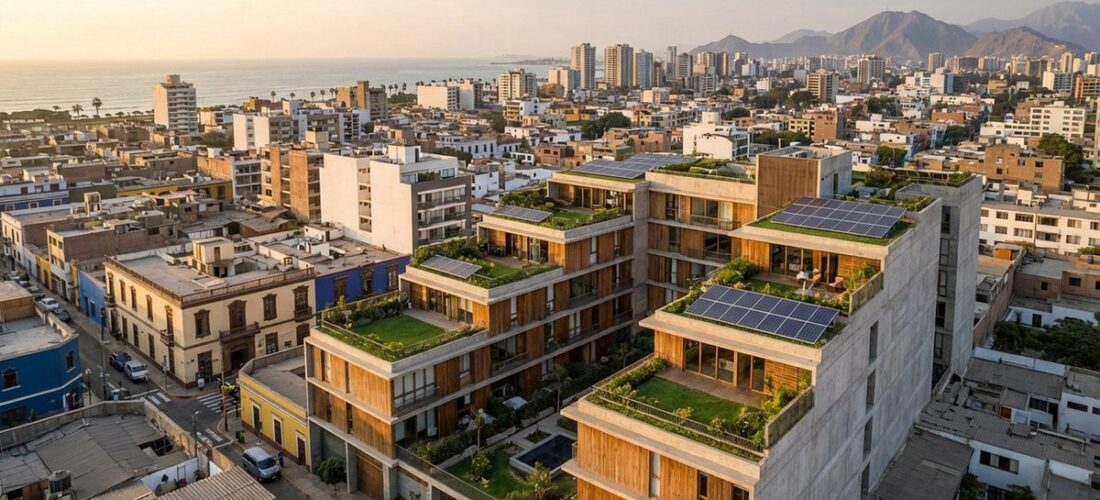
The MiVivienda Verde program is the Fund most innovative financing line, aimed at incentivizing the construction and acquisition of homes that incorporate environmental sustainability criteria. Homes that qualify as “green” must meet specific standards in water efficiency, energy efficiency, and use of sustainable materials.
Sustainability criteria
For a home to be certified as MiVivienda Verde, it must meet at least three of the following criteria:
- Water savings: Installation of low-consumption faucets and fixtures that reduce water use by at least 30%. This includes dual-flush systems, faucet aerators, and low-flow showers.
- Energy efficiency: Use of LED lighting, Class A or higher appliances, and architectural design that maximizes natural lighting. Building orientation to maximize sunlight exposure is particularly valued.
- Sustainable materials: Use of environmentally certified, recycled, or low-impact construction materials. Local suppliers are prioritized to reduce the carbon footprint of transportation.
- Green areas: Incorporation of community gardens, green roofs, or landscaping systems that contribute to urban biodiversity and resident wellbeing.
- Waste management: Designated spaces for recyclable waste separation and community composting systems.
Economic benefits of the Green Bonus
Families purchasing a MiVivienda Verde certified home receive significant additional benefits including reduced interest rates, higher subsidy amounts, and extended repayment terms. The Green Bonus provides up to 4% of the property value as a non-refundable subsidy, in addition to the standard Good Payer Bonus.
How to Apply for MiVivienda Verde
Step-by-step application process
- Verify eligibility: The applicant must not own any property and must have a monthly household income below 3,626 PEN for Techo Propio or between 3,626 and 7,252 PEN for MiVivienda.
- Choose a certified project: Select a housing project that has MiVivienda Verde certification. The list of certified projects is available on the official website.
- Select a financial institution: Choose from authorized banks and financial entities that manage MiVivienda credits.
- Submit documentation: Provide identification, proof of income, credit history, and the initial deposit (minimum 10% of the property value).
- Credit evaluation: The financial institution evaluates the application and approves the credit.
- Signing and disbursement: Upon approval, the purchase contract is signed and the subsidy is applied to the final price.
Impact and Results in Lima
Since its implementation, the MiVivienda Verde program has transformed the sustainable housing market in Lima. By 2024, over 50,000 green-certified homes had been built in the metropolitan area, generating annual savings of approximately 15% in water consumption and 20% in electricity for each beneficiary household.
The program has also stimulated the local construction industry to adopt more sustainable practices, creating a virtuous cycle between environmental demand and green building supply. Districts like Villa El Salvador, Carabayllo, and San Juan de Lurigancho have been the main beneficiaries, with large-scale residential projects that combine affordability with sustainability.