
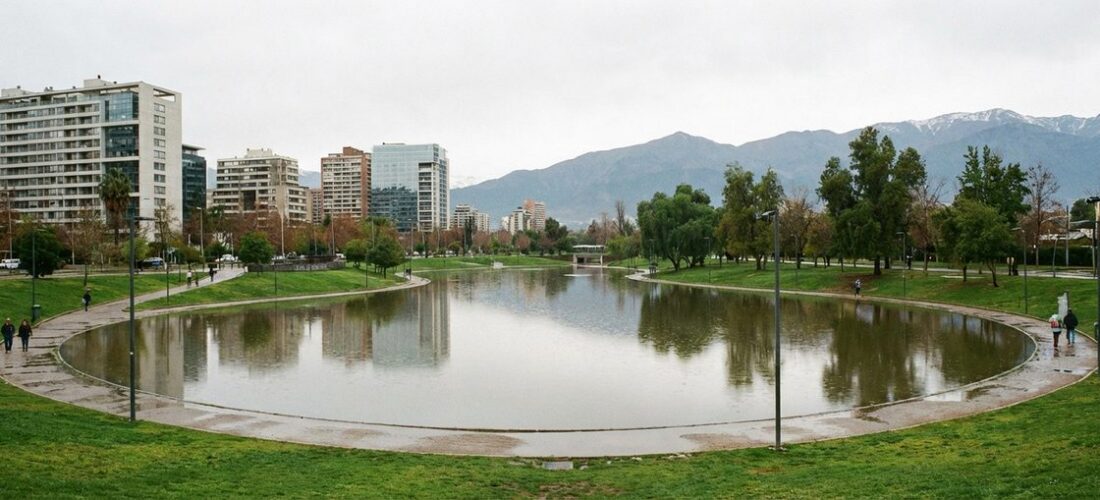
Víctor Jara Flood Park: The Park That Controls Flooding in Santiago
Parque Inundable Víctor Jara: Santiago’s Innovative Flood Control Park
In the southern district of Pedro Aguirre Cerda in Santiago, Chile, an unassuming urban park performs a remarkable dual function: by day it serves as a recreational green space for surrounding neighborhoods; during heavy rains, it transforms into a massive stormwater retention basin, protecting thousands of homes from flooding. The Parque Inundable Víctor Jara — named after the legendary Chilean musician and social activist — represents one of Latin America’s most innovative approaches to urban flood management through nature-based infrastructure.
Inaugurated in 2012, the park was developed as a response to chronic flooding that had plagued Santiago’s southern communities for decades. Rather than investing in conventional underground drainage infrastructure — expensive to build and maintain — engineers and landscape architects designed a public park that could absorb and temporarily store massive volumes of stormwater while providing year-round recreational benefits to a neighborhood that had long been underserved in terms of green space.
The Flooding Problem in Southern Santiago
Santiago’s geography creates a particular vulnerability to urban flooding. The city sits in a valley between the Andes mountains to the east and the coastal range to the west. Rainfall, concentrated in the winter months of June through August, runs rapidly off the steep terrain and into the flatlands of southern Santiago, where poor drainage infrastructure and extensive impervious surfaces create severe flooding during storms.
The communities most affected by flooding have historically been among the city’s poorest. Neighborhoods like Pedro Aguirre Cerda, La Granja, and San Ramón were developed rapidly during the mid-twentieth century with minimal drainage infrastructure. Streets would regularly flood to depths of 30 to 50 centimeters during heavy rains, damaging homes, disrupting transportation, and creating public health risks from contaminated floodwater.
The economic impact was substantial. Annual flood damage in southern Santiago was estimated at millions of dollars, with low-income households bearing a disproportionate burden. Traditional solutions — larger storm drains, concrete channels, pump stations — would have required billions in investment and years of disruptive construction.
How the Flood Park Works
The Dual-Function Design
The Parque Inundable Víctor Jara occupies approximately 4.2 hectares of what was previously underutilized public land. The park is designed at a level deliberately lower than the surrounding streets and buildings, creating a natural bowl that can receive and store stormwater during heavy rainfall events.
The park’s design operates on a simple but elegant principle: during normal conditions, the depressed areas function as sports fields, playgrounds, and gathering spaces. When rainfall exceeds the capacity of the conventional drainage system, stormwater is directed into the park through a series of inlet channels and controlled overflow points. The park can store approximately 62,000 cubic meters of water — equivalent to roughly 25 Olympic swimming pools — reducing peak flows in the downstream drainage network by up to 30%.
The Flooding System in Detail
The park’s stormwater management system includes several engineered components integrated into the landscape design:
- Inlet channels: Concrete channels along the park’s perimeter direct stormwater from surrounding streets into the retention area. These channels are designed as landscape features — stone-lined watercourses that are dry most of the year but activate during rain events.
- Graduated depth zones: The park’s interior is divided into zones of different depths. Shallow areas (30-50 cm) flood first during moderate rains and are designed with robust ground cover that tolerates periodic inundation. Deeper zones (up to 1.5 meters) activate only during more severe events.
- Controlled outlet: A regulated outlet structure at the park’s lowest point slowly releases stored water into the downstream drainage system after the storm passes. The outlet is designed to release water at a rate the drainage network can handle, preventing downstream flooding.
- Overflow spillway: For extreme events exceeding the park’s capacity, an emergency spillway directs excess water safely to the nearest major drainage channel.
- Subsurface infiltration: Permeable surfaces in parts of the park allow some stored water to infiltrate into the ground, recharging the water table and reducing the total volume that must be discharged through the drainage network.
Recovery After Flooding
A critical aspect of the design is rapid recovery after flooding events. The park is designed to drain completely within 24 to 48 hours after a storm. Vegetation species were selected for their ability to tolerate both dry conditions and temporary submersion. Hard surfaces (sports courts, pathways) are constructed with quick-draining materials and slightly elevated to minimize damage and cleaning requirements after inundation.
Park Design and Community Amenities
While its flood control function is the engineering achievement, the park’s success depends equally on its quality as a public space. The design team — led by landscape architects who consulted extensively with local residents — created a park that serves the recreational and social needs of surrounding neighborhoods:
- Multi-purpose sports courts for football and basketball, located in the moderate-depth flood zone
- Children’s playground on elevated ground that remains dry during all but the most extreme events
- Walking and cycling paths that follow the park’s perimeter at a level above the flood zone
- Community gathering areas with seating, shade structures, and open lawn spaces
- Native vegetation zones that provide habitat for urban wildlife while serving as natural filtration for stormwater
- Public art installations honoring Víctor Jara’s legacy and the community’s history
The naming of the park after Víctor Jara — the musician, theater director, and political activist who was murdered during the 1973 military coup — carries deep significance for the surrounding community. Jara was closely associated with social justice movements and the cultural life of working-class neighborhoods, making the name a powerful symbol for a public space that addresses long-standing inequities in urban infrastructure.
Environmental Impact
Water Quality Improvement
Beyond flood control, the park provides meaningful water quality benefits. As stormwater flows through the park’s vegetated areas, sediments settle out and biological processes remove pollutants. This natural treatment function reduces the contamination load reaching downstream waterways — a significant benefit in a city where urban runoff is a major source of water pollution.
Urban Heat Island Reduction
The park’s vegetation contributes to cooling the surrounding urban area. Southern Santiago has some of the city’s lowest ratios of green space per capita, and the heat island effect is a growing concern as temperatures rise. Monitoring data suggests the park reduces ambient temperatures by 2-3°C in its immediate vicinity during summer months.
Biodiversity Habitat
The park’s varied habitats — including temporarily wet areas, dry grasslands, and planted groves — support a surprisingly diverse urban ecology. Bird surveys have documented over 20 species using the park, including several that depend on wetland-like conditions that are otherwise rare in the urban landscape.
A Model for Latin American Cities
The Parque Inundable Víctor Jara has become a reference project for urban flood management across Latin America. Its success has inspired similar projects in other Chilean cities and has been studied by engineers and planners from across the region. Several factors make it particularly relevant as a model:
- Cost-effectiveness: The park cost a fraction of what equivalent underground drainage capacity would have required, while providing recreational benefits that a buried pipe never could
- Social equity: The project brought high-quality green space to an underserved community — addressing both flood risk and recreational needs in a single investment
- Climate resilience: As climate change increases the intensity and frequency of extreme rainfall events, flexible green infrastructure like flood parks can be adapted more easily than rigid engineered systems
- Replicability: The basic concept — using depressed public spaces for dual recreational and stormwater functions — can be adapted to different scales, climates, and urban contexts
- Community acceptance: By providing visible, daily benefits as a park, the project maintains public support even though its flood control function activates only occasionally
Cities across Latin America — from Bogotá to Lima to Mexico City — face similar challenges of urban flooding, inadequate drainage, and insufficient green space in low-income neighborhoods. The Víctor Jara park demonstrates that these challenges can be addressed simultaneously through intelligent design that works with natural water systems rather than against them.
Challenges and Future Development
The park is not without limitations. Maintenance requirements are higher than for conventional drainage infrastructure, as the vegetated surfaces and inlet structures need regular attention. During extended periods of flooding, the park’s recreational function is temporarily lost — though this typically occurs during winter months when park usage is already lower.
There have also been discussions about expanding the flood park concept to other sites in southern Santiago. Several additional locations have been identified where similar dual-function parks could further reduce flood risk while expanding the green space network in underserved areas. The success of the Víctor Jara park has made these proposals politically viable in a way that would not have been possible before the concept was proven in practice.
The Parque Inundable Víctor Jara stands as a testament to the power of integrated urban design — demonstrating that infrastructure can be beautiful, that parks can be functional, and that the most innovative solutions to urban problems often come from refusing to treat engineering and community needs as separate concerns.