BRT Rio de Janeiro: How Rapid Transit Changed Mobility in Rio
BRT Rio de Janeiro: Bus Rapid Transit and the Olympic Legacy
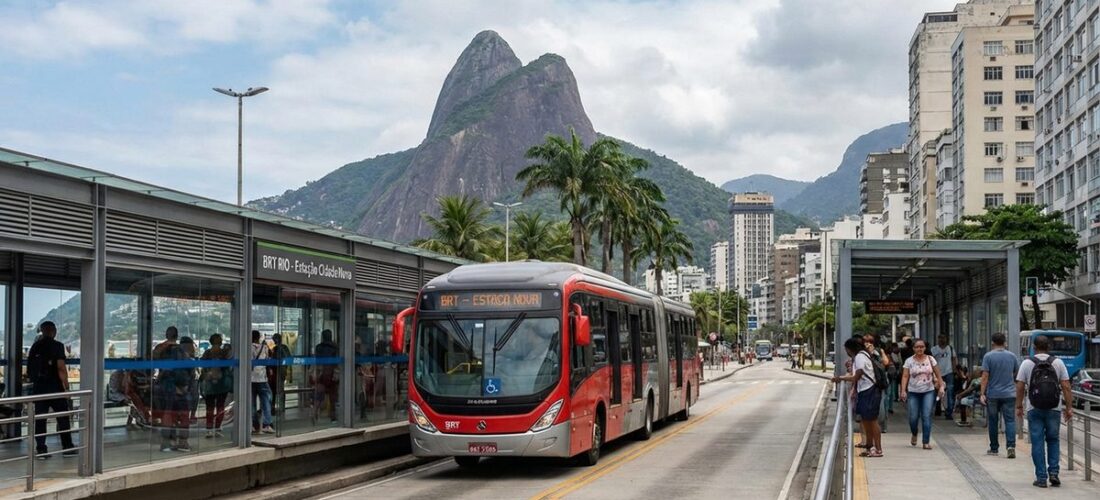
Rio de Janeiro’s BRT system is one of the largest bus rapid transit networks in Latin America, built primarily between 2012 and 2016 as part of the massive infrastructure investment surrounding the 2014 FIFA World Cup and the 2016 Summer Olympic Games. Spanning over 150 kilometers across four major corridors, the system was designed to connect the city’s sprawling western suburbs and northern zones to the center, dramatically reshaping mobility patterns for millions of cariocas.
The story of BRT in Rio is one of ambitious vision, significant achievement, and sobering challenges — a case study in both the potential and the pitfalls of mega-event-driven infrastructure development.
The Four BRT Corridors
TransOeste
The first corridor to open, TransOeste began operations in June 2012. Running approximately 56 kilometers from the Barra da Tijuca district to Santa Cruz in the far west, it was designed to serve some of Rio’s fastest-growing and most car-dependent suburbs. The corridor includes 60 stations, with services operated by articulated buses running on dedicated lanes separated from general traffic.
TransOeste was designed to address one of Rio’s most pressing mobility challenges: the long, congested commutes faced by residents of the western zone, many of whom spent two to three hours each way traveling to jobs in the city center. Before the BRT, these commuters relied on a combination of overcrowded conventional buses and informal vans (kombis) operating on severely congested highways.
TransCarioca
Opened in June 2014 — just days before the World Cup began — TransCarioca runs 39 kilometers from Barra da Tijuca to the Tom Jobim International Airport (Galeão) in the northern zone. This east-west corridor was strategically important as it connected the Olympic venues in Barra to the airport and to densely populated northern neighborhoods.
TransCarioca crosses some of Rio’s most complex urban landscapes, passing through Jacarepaguá, Madureira, and Penha. It includes 47 stations and was designed to integrate with the existing metro, commuter rail, and bus networks at several key interchange points.
TransOlímpica
As its name suggests, TransOlímpica was built specifically for the 2016 Olympics, connecting the two main Olympic clusters: Deodoro (in the north) and Barra da Tijuca (in the west). The 26-kilometer corridor opened in August 2016, just days before the Games began. Running largely through undeveloped or low-density areas, TransOlímpica was as much a tool of urban development as of transportation — intended to catalyze growth in the corridor between the two Olympic venues.
TransBrasil
The fourth and most ambitious corridor, TransBrasil, was planned to run along Avenida Brasil — one of the city’s most important and most congested highways — from Deodoro to the city center. This 32-kilometer corridor through the heart of the northern zone would have served some of Rio’s densest and poorest neighborhoods. However, TransBrasil has faced repeated delays due to funding shortages, legal disputes, and construction complications. As of the mid-2020s, the corridor remains partially complete, a symbol of the broader challenges facing Rio’s post-Olympic infrastructure ambitions.
Impact on Urban Mobility
When the operational corridors are functioning as designed, the BRT system has delivered meaningful mobility improvements:
- Travel time reductions of 40-60% on routes previously served by conventional buses in mixed traffic
- Combined capacity to transport over 450,000 passengers per day across the three operational corridors
- Improved access to employment centers for residents of the western and northern zones, where job access had been limited by long, unpredictable commutes
- Integration with other modes: Transfer stations connecting BRT to the metro (at several points), commuter rail, conventional buses, and the VLT (light rail) in the port area
The system has been particularly significant for residents of Barra da Tijuca and the far western suburbs, areas that had been essentially car-dependent due to the absence of rail connections. For the first time, residents of neighborhoods like Santa Cruz, Campo Grande, and Recreio could reach major employment and service centers via a reliable, medium-capacity transit system.
The Olympic Legacy: Achievements and Questions
What Worked
The mega-event deadline undeniably accelerated infrastructure delivery. Rio built more than 100 kilometers of dedicated bus corridors in less than five years — a pace that would likely have been impossible under normal budgetary and political conditions. The system introduced modern BRT concepts to Rio, including prepaid boarding, level access, real-time passenger information, and dedicated rights-of-way.
The BRT also demonstrated that bus-based transit could serve as a backbone network in a large, geographically complex city where metro extension is prohibitively expensive. Rio’s challenging topography — hills, lagoons, and long coastlines — makes rail construction difficult and costly, giving BRT a structural advantage.
What Has Struggled
However, the system’s post-Olympic trajectory has been troubled. Several factors have undermined performance:
- Maintenance deficits: Stations, vehicles, and infrastructure have deteriorated faster than expected, partly due to construction shortcuts made to meet event deadlines and partly due to insufficient maintenance funding
- Overcrowding: On the busiest corridors, particularly TransOeste, demand has exceeded capacity during peak hours, leading to severely overcrowded vehicles and long waits at stations
- Service reliability: Vehicle breakdowns, station closures, and irregular schedules have eroded public confidence in the system
- Safety concerns: Crime at stations and on vehicles has been a persistent issue, particularly in the evening hours and at more isolated stations
- Financial sustainability: The operating companies have faced financial difficulties, leading to service reductions and fleet maintenance issues
Current Status and Ongoing Challenges
The Rio BRT system continues to operate but at a level below its designed potential. The three operational corridors (TransOeste, TransCarioca, and TransOlímpica) carry substantial daily ridership, but service quality has fluctuated. The unfinished TransBrasil corridor remains the system’s most significant gap — its completion would connect the existing network to the city center and serve the northern zone’s dense population.
Efforts to revitalize the system have included renegotiation of operating contracts, investment in vehicle replacement, and station rehabilitation programs. There is growing recognition that the BRT infrastructure represents a valuable public asset that warrants sustained investment, even if the post-Olympic fiscal environment has made this challenging.
Lessons for Other Cities
Rio’s BRT experience offers important lessons for cities considering similar investments:
- Mega-events can catalyze infrastructure but the pressure to meet deadlines can compromise quality and long-term sustainability
- Operational planning must match infrastructure ambition: Building corridors is only half the challenge; sustainable operations require ongoing funding, institutional capacity, and political commitment
- Equity impacts matter: BRT can significantly improve mobility for underserved communities, but only if service quality is maintained over time
- Integration is essential: BRT works best as part of an integrated multi-modal network, not as a standalone system
- Maintenance cannot be deferred: BRT infrastructure requires consistent investment in maintenance to maintain service quality and public trust
Despite its challenges, Rio de Janeiro’s BRT system represents a significant addition to the city’s transportation infrastructure. The corridors serve millions of riders, connect previously isolated communities to the broader city, and provide a foundation that — with adequate investment and management — can continue to improve mobility for cariocas for decades to come. The key question is whether the political will and financial resources can be mobilized to realize that potential.