Solid Waste Management: Success Stories in Latin America
The Waste Challenge in Latin America
Latin America generates approximately 540,000 tons of municipal solid waste every day — roughly 1 kilogram per person. Yet despite decades of urbanization and economic growth, the region’s average recycling rate remains below 5%, and an estimated 40 million people still lack access to adequate waste collection services. Open dumps persist in hundreds of cities, contaminating groundwater, generating methane emissions, and creating severe public health hazards for nearby communities.
Against this challenging backdrop, several Latin American cities have developed innovative solid waste management programs that demonstrate what is possible when political will, community engagement, and appropriate technology converge. These success stories — from the Amazon basin to the Andes, from megacities to mid-sized urban centers — offer replicable models for municipalities across the developing world.
Iquitos, Peru: Waste Collection in the Belén District
Iquitos, the largest city in the Peruvian Amazon with approximately 500,000 inhabitants, faces waste management challenges unlike any other major Latin American city. The Belén district — often called the “Venice of the Amazon” — is a floating neighborhood where thousands of families live in houses built on stilts or rafts above the Itaya River. Traditional wheeled waste collection is physically impossible in most of Belén, and for decades, residents had no alternative but to dump waste directly into the river.
The River-Based Collection System
Through a partnership between the municipal government, international cooperation programs, and community organizations, Iquitos developed a river-based waste collection system specifically designed for Belén’s unique geography:
- Motorized collection boats: Small, flat-bottomed boats navigate the waterways of Belén on fixed routes, collecting waste directly from households along the river channels.
- Floating collection points: At strategic locations, floating platforms serve as temporary waste aggregation points, reducing collection boat routes and improving efficiency.
- Community promoters: Trained local residents — predominantly women — conduct door-to-door outreach, distributing bags and encouraging source separation.
- Transfer to land-based system: Collected waste is transported by boat to a land-based transfer station at the edge of the floating district, where it joins the conventional municipal collection system.
Results and Challenges
The program achieved a 70% waste collection coverage rate in Belén within its first two years — up from effectively zero. River contamination measurements showed significant reductions in floating solid waste along collection routes. However, sustainability remains a challenge: the program’s operating costs per ton are approximately three times higher than conventional collection due to the specialized equipment and labor-intensive routes. Continued external funding support has been essential to maintaining service levels.
Santiago, Chile: The Puntos Limpios Network
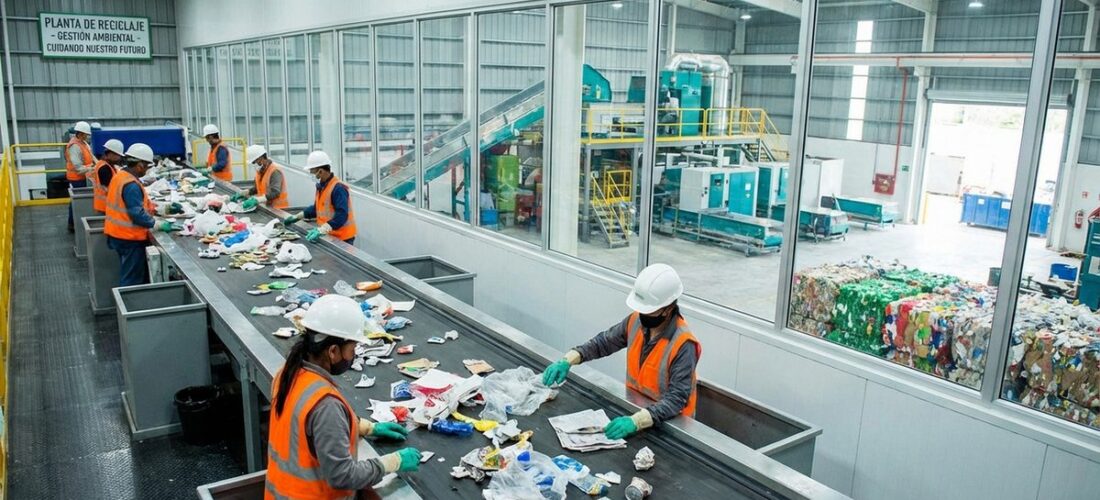
Santiago’s approach to improving recycling rates centers on a metropolitan network of Puntos Limpios — staffed drop-off facilities where residents bring sorted recyclable materials. Operating across more than 40 locations in the Santiago Metropolitan Region, the program has become one of the most successful recycling infrastructure initiatives in Latin America.
Program Design
Each Punto Limpio accepts a wide range of recyclables including paper, cardboard, PET and HDPE plastics, glass, metals, Tetra Pak cartons, and used cooking oil. Trained staff assist visitors in correct sorting and provide environmental education. The facilities are strategically located near public transport, parks, and commercial areas to maximize accessibility.
Scale and Impact
- Diversion volumes: The network collectively diverts over 30,000 tons of recyclables from landfills annually.
- Participation growth: Over 2 million individual visits were recorded in 2024, with 67% of users visiting at least monthly.
- Recycling rate improvement: Comunas with established Puntos Limpios have seen household recycling rates rise from under 5% to 12-18%.
- Job creation: Approximately 500 direct jobs in facility operations.
Chile’s Extended Producer Responsibility (REP) law, enacted in 2016, has created a sustainable funding mechanism by requiring packaging producers to finance collection and recycling infrastructure. This regulatory framework ensures the Puntos Limpios program can continue expanding without total dependence on municipal budgets.
Bogotá, Colombia: Integrating Informal Waste Pickers
Bogotá’s waste management story is inseparable from its recognition and formalization of recicladores de oficio — the informal waste pickers who had for decades recovered recyclable materials from the city’s waste stream without legal recognition, labor protections, or fair compensation. A landmark 2003 Constitutional Court ruling, and subsequent decisions through 2014, transformed Bogotá into a global pioneer in waste picker integration.
The Legal and Institutional Framework
Colombia’s Constitutional Court ruled that waste pickers perform a legitimate public service — recyclable material recovery — and that the city must compensate them for this service on terms comparable to those offered to private waste collection companies. This judicial mandate forced Bogotá to restructure its waste management system:
- Registration and organization: Waste picker cooperatives were formally registered as authorized service providers within the municipal waste management system.
- Payment for service: Registered waste picker organizations receive per-ton payments from a tariff system built into residents’ public utility bills — the same mechanism that funds conventional collection companies.
- Route formalization: Waste picker organizations were assigned exclusive collection routes for recyclable materials, preventing competition and route overlap.
- Infrastructure support: The city provided collection vehicles, sorting centers, and personal protective equipment to registered organizations.
Results
By 2024, over 25,000 waste pickers were registered in Bogotá’s formal waste management system, organized into approximately 300 cooperatives and associations. These organizations collectively recover an estimated 1,200 tons of recyclable materials daily — representing over 20% of the city’s total recyclable waste stream. Bogotá’s model has been studied and adapted by cities including Belo Horizonte (Brazil), Lima (Peru), and Pune (India).
Ongoing Challenges
Despite its pioneering status, Bogotá’s waste picker integration program faces persistent difficulties. Many waste pickers remain outside the formal system, working independently in conditions of poverty and precarity. Payment levels, while an improvement over the informal economy, often fall below minimum wage when calculated per hour. And the transition from individual waste picking to organized cooperative management requires ongoing training and institutional support that has been inconsistently provided.
Lima, Peru: Modernizing Metropolitan Waste Management
Lima, home to over 10 million people, generates approximately 8,000 tons of municipal solid waste daily. The city’s waste management challenges are compounded by its fragmented governance structure: the Lima metropolitan area comprises 43 autonomous district municipalities, each responsible for its own waste collection, with the Metropolitan Municipality of Lima coordinating disposal at the regional level.
Key Initiatives
- Selective collection programs: Several districts — including Miraflores, San Borja, and Surco — have implemented source-separation programs where households receive color-coded bags and separate collection routes service recyclable materials.
- Sanitary landfill improvements: Lima has invested in upgrading its principal disposal facilities, including the Portillo Grande landfill, with leachate treatment systems, gas capture infrastructure, and improved compaction equipment.
- Waste picker formalization: Following Bogotá’s model, several Lima districts have begun formalizing relationships with recicladores, providing protective equipment and integrating them into selective collection routes.
- Composting pilots: District municipalities including Villa El Salvador and Pachacámac have established community composting facilities processing organic waste from local markets and green spaces.
The OEFA Enforcement Role
Peru’s Environmental Assessment and Enforcement Agency (OEFA) conducts annual evaluations of municipal waste management performance, ranking all district municipalities and publishing results publicly. This transparency mechanism has created competitive pressure among Lima’s districts, with top-performing municipalities highlighting their rankings as governance achievements and lagging municipalities facing public scrutiny and potential sanctions.
Curitiba, Brazil: The Pioneer Model
No discussion of Latin American waste management innovation is complete without Curitiba, the capital of Paraná state in southern Brazil. Under the visionary leadership of Mayor Jaime Lerner in the 1970s through 1990s, Curitiba developed an integrated waste management system that became one of the most studied urban sustainability models worldwide.
The Câmbio Verde Program
Curitiba’s most celebrated waste initiative is Câmbio Verde (Green Exchange), launched in 1991. The program allows residents — particularly in low-income neighborhoods with narrow streets inaccessible to collection trucks — to exchange sorted recyclable materials and organic waste for fresh produce, bus tokens, and school supplies. The exchange rates are calibrated to make recycling economically attractive: four kilograms of recyclables typically earn one kilogram of fresh seasonal produce sourced from local farmers.
Lixo Que Não É Lixo
The “Lixo Que Não É Lixo” (Trash That Isn’t Trash) program, launched in 1989, was one of Latin America’s first citywide source-separation collection programs. Color-coded trucks collect recyclable materials on designated days, with near-universal coverage across the city. The program’s memorable branding — including mascot characters and school education campaigns — achieved extraordinary public recognition: surveys consistently show over 95% awareness among Curitiba residents.
Legacy and Current Status
Curitiba’s waste management programs have endured through multiple changes of municipal government, demonstrating the institutional sustainability that often eludes innovative programs in Latin America. The city consistently achieves recycling rates of 20-25% — among the highest in Brazil — and its programs have been adapted by hundreds of Brazilian municipalities. The Curitiba model demonstrates that effective waste management in developing countries requires not just technical infrastructure but creative incentive design, persistent public education, and programs that deliver tangible benefits to participating communities.
Common Success Factors
Across these diverse contexts — from the floating neighborhoods of Iquitos to the organized cooperatives of Bogotá — several common factors distinguish successful waste management programs in Latin America:
- Community engagement: Programs that invest in door-to-door outreach, environmental education, and tangible incentives for participation consistently outperform those that rely solely on infrastructure provision.
- Recognition of informal sector: Cities that integrate existing waste pickers into formal systems — rather than displacing them — achieve both higher recycling rates and better social outcomes.
- Appropriate technology: Successful programs match technology to context. Iquitos uses boats because trucks cannot reach Belén. Santiago uses staffed drop-off centers because curbside separation contamination rates were too high. Curitiba uses exchange programs because monetary incentives alone were insufficient in low-income areas.
- Regulatory frameworks: Chile’s REP law and Colombia’s Constitutional Court rulings demonstrate that legal and regulatory mandates create the institutional stability needed for long-term program success.
- Persistent political commitment: Curitiba’s programs have endured for over 30 years because successive governments maintained and evolved them. Cities where waste management programs depend on a single political champion often see those programs dismantled when administrations change.
These Latin American experiences offer valuable lessons for cities worldwide confronting the challenge of managing growing waste streams with limited resources. The creativity, adaptability, and community orientation demonstrated by these programs suggest that effective waste management is less a technical problem than a governance and social mobilization challenge — one that Latin American cities are uniquely positioned to address.