
Buenos Aires Metrobus Network: The BRT That Transformed Urban Mobility
Buenos Aires Metrobus: How Bus Rapid Transit Transformed Urban Mobility
The Metrobus network of Buenos Aires is one of the most successful bus rapid transit (BRT) systems implemented in any Latin American capital in the past two decades. Launched in 2011 with a single corridor along Avenida Juan B. Justo, the network has expanded to multiple lines serving millions of passengers monthly, dramatically reducing travel times and reshaping how porteños move through their city.
Buenos Aires’ Metrobus system demonstrates how a relatively modest infrastructure investment — dedicated bus lanes, modern stations, and intelligent traffic management — can achieve transformative improvements in urban mobility without the massive cost and construction time of rail-based alternatives.
The Mobility Crisis That Sparked Change
Before the Metrobus, Buenos Aires faced a deepening public transportation crisis. The city’s bus network — operated by over 100 private companies running more than 30,000 buses — was extensive but increasingly unreliable. Buses crawled through congested streets, with average speeds on major corridors falling below 10 km/h during peak hours. A trip that should have taken 30 minutes could easily stretch to 90 minutes or more.
The consequences were severe: lost productivity, increased air pollution, growing reliance on private cars (which worsened congestion further), and a declining quality of life for the millions of residents who depended on public transportation. Low-income commuters were particularly affected, as longer travel times meant less time with families and higher effective transportation costs.
Previous attempts to address the problem had focused on building new Subte (metro) lines — an approach that, while effective, was prohibitively expensive and slow. A single metro line extension could take a decade and cost billions of dollars. The city needed a solution that could be implemented quickly and affordably while still delivering meaningful improvements.
The Metrobus Solution
Line 1: Juan B. Justo (2011)
The first Metrobus corridor opened in May 2011 along Avenida Juan B. Justo, stretching 12.5 kilometers through the western part of the city. The corridor was chosen for several reasons: it carried high bus volumes (over 50,000 daily passengers), suffered severe congestion, and had sufficient road width to accommodate dedicated bus lanes without eliminating all general traffic lanes.
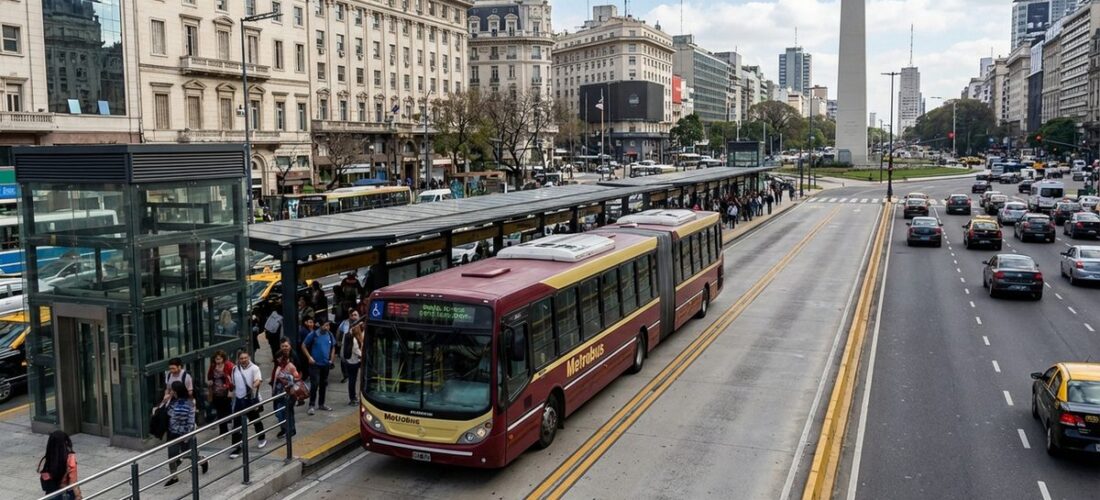
The design was straightforward: two central lanes were reserved exclusively for buses, separated from general traffic by physical barriers. Modern stations with raised platforms, weather protection, and real-time arrival information were installed at regular intervals. Traffic signals were coordinated to give priority to buses, and the entire corridor was equipped with electronic monitoring systems.
The results were immediate and dramatic. Average bus speeds on the corridor increased from 8 km/h to 22 km/h — nearly tripling. Total travel time for end-to-end trips dropped by approximately 40%. Bus reliability improved significantly, with more consistent headways and fewer delays.
Line 2: 9 de Julio (2013)
The second line, opened along the iconic Avenida 9 de Julio — one of the world’s widest avenues — was a bold statement of political commitment. Running 3 kilometers through the city center, this corridor connected the Retiro and Constitución railway terminals, two of the city’s busiest transportation hubs. Given the avenue’s symbolic importance, the project generated considerable debate, but the benefits quickly silenced most critics.
Subsequent Expansions
The network continued to grow through the mid-2010s and beyond:
- Line 3 — Autopista 25 de Mayo: A unique corridor running along a section of urban highway, serving the southern districts
- Line 4 — Avenida San Martín: Extending service to the northwest, connecting dense residential neighborhoods to the city center
- Line 5 — Avenida Cabildo / Maipú: Serving the northern corridor through Belgrano and Núñez
- Line 6 — Autopista AU1: Running along the northern highway corridor
- Line 7 — Avenida del Libertador: Connecting northern suburbs through one of the city’s most important avenues
By the mid-2020s, the Metrobus network extended over 62 kilometers across the city, with plans for further expansion.
Ridership and Performance Data
The Metrobus network has consistently delivered strong performance metrics:
- Daily ridership: Over 1.1 million passengers across all lines
- Travel time reduction: Average savings of 30-40% compared to pre-Metrobus conditions on the same corridors
- Bus speeds: Average operating speeds of 20-25 km/h, compared to 8-12 km/h in mixed traffic
- Reliability: Significantly reduced variation in trip times, making the system more predictable for commuters
- Safety: Reduction in traffic accidents on Metrobus corridors, attributed to the physical separation of buses from general traffic and improved pedestrian crossings
Impact on Urban Mobility and Quality of Life
Time Savings
The most tangible benefit for users is time savings. A commuter traveling the length of the Juan B. Justo corridor who previously spent 50 minutes on the bus now completes the trip in approximately 30 minutes. Across the network, the Metrobus is estimated to save its riders a collective several million hours per year — time that translates directly into improved quality of life, additional time with families, and economic productivity.
Environmental Benefits
By improving bus efficiency and attracting some riders away from private cars, the Metrobus has contributed to reducing transportation-related emissions. Faster bus speeds mean less fuel consumed per passenger-kilometer, while the modal shift from cars to buses reduces overall vehicular emissions. Several corridors have also prompted the introduction of newer, cleaner bus fleets.
Urban Space Reallocation
The Metrobus projects have typically included improvements to the surrounding streetscape: wider sidewalks, new pedestrian crossings, improved lighting, and tree planting. These interventions have improved the quality of urban space along the corridors, benefiting not just bus riders but all residents and businesses in the area.
Property Values
Studies of the impact on property values along Metrobus corridors have shown modest but consistent increases, suggesting that the infrastructure is perceived as an amenity rather than a nuisance. This is significant given the concern, common in many cities, that bus infrastructure will negatively affect property values.
Comparison with Other Latin American BRT Systems
Buenos Aires’ Metrobus sits within a rich tradition of Latin American BRT innovation. Comparing it with other systems in the region highlights both its strengths and its limitations:
- Curitiba (Brazil): The pioneer of BRT, Curitiba’s system features tube stations, prepaid boarding, and articulated buses. Buenos Aires adopted some of these features but in a lighter, faster-to-implement format.
- Bogotá (TransMilenio): A high-capacity system with fully enclosed stations and trunk-feeder operations. TransMilenio carries more passengers but required significantly higher investment. Buenos Aires opted for a lighter model that could be implemented incrementally.
- Mexico City (Metrobús): Similar in concept to Buenos Aires, Mexico City’s system has expanded on a comparable timeline and scale, and the two cities have exchanged technical knowledge.
- Santiago (Transantiago/RED): Santiago’s system integration attempted a more radical transformation but faced significant implementation challenges. Buenos Aires’ incremental approach avoided some of these disruptions.
The Buenos Aires model is sometimes characterized as “BRT lite” — less infrastructure-intensive than systems like TransMilenio but significantly more effective than conventional bus operations. This lighter approach has been its greatest advantage, enabling rapid implementation at relatively low cost.
Challenges and Criticisms
The Metrobus system has faced several ongoing challenges:
- Capacity constraints: On the busiest corridors, the system approaches capacity during peak hours, with crowded stations and full buses — raising questions about whether BRT alone can meet long-term demand
- Network integration: While individual corridors perform well, integration between Metrobus lines and other transportation modes (Subte, commuter rail, bicycles) could be improved
- Enforcement: Keeping general traffic out of dedicated bus lanes requires constant enforcement. Encroachment by cars, taxis, and delivery vehicles remains a persistent issue on some corridors
- Accessibility: While stations are designed for wheelchair access, actual accessibility can be compromised by maintenance issues, crowding, and gaps between platforms and buses
- Coverage equity: Critics note that corridor selection has sometimes favored more visible, politically advantageous routes over those serving the communities with the greatest transportation needs
Expansion Plans and Future Vision
The Buenos Aires government has outlined plans for further Metrobus expansion, with new corridors proposed for several major avenues that currently lack dedicated bus infrastructure. There is also growing discussion about upgrading the busiest corridors to higher-capacity BRT standards — with features like articulated buses, off-board fare collection, and passing lanes at stations — to address capacity constraints.
Integration with cycling infrastructure has become a priority, with several Metrobus corridors now paired with protected bicycle lanes. The combination of fast, reliable bus service with safe cycling infrastructure creates a compelling alternative to private car use for a wide range of trips.
The Metrobus experience has demonstrated that Buenos Aires — and by extension, other Latin American cities facing similar challenges — does not need to choose between doing nothing and building enormously expensive rail systems. A well-designed BRT system, implemented incrementally and adapted to local conditions, can deliver transformative improvements in urban mobility at a fraction of the cost and time of alternatives. The challenge now is to build on this success, expanding and upgrading the network to keep pace with the city’s evolving transportation needs.